
Guides · Importing into Switzerland
Importing a motorhome into Switzerland: the completed vehicle COC
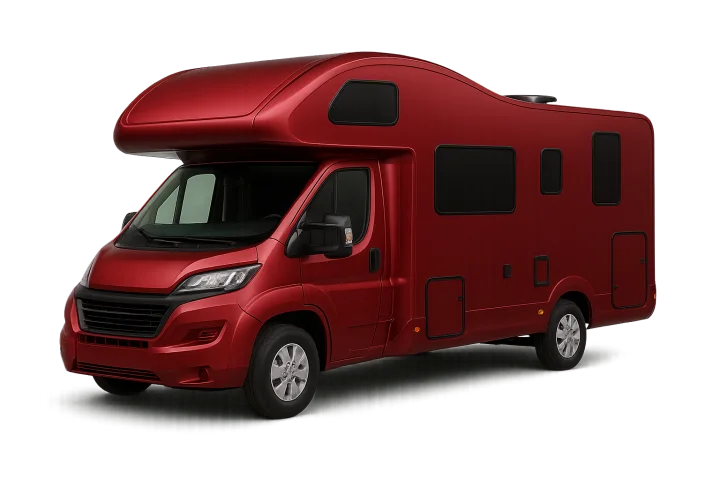
To register an imported motorhome in Switzerland, the certificate of conformity (COC) to present is that of the completed vehicle, issued by the motorhome manufacturer, for example Hymer, and not just that of the base vehicle supplied by Fiat or Mercedes-Benz. At customs, 8.1% VAT and the 4% automobile tax are due, unless the motorhome is registered with a total weight above 3500 kg, in which case the 4% tax falls away.
A vehicle built in several stages
Regulation (EU) 2018/858 provides for multi-stage type approval for vehicles that do not leave a single factory finished. A motorhome built on another manufacturer's base vehicle is one of them:
- a vehicle manufacturer supplies a base vehicle, incomplete within the meaning of the regulation because it still has to go through at least one further stage;
- the motorhome manufacturer fits the living unit and obtains approval for the completed vehicle.
Each manufacturer is responsible for its own stage and issues its own certificate. The completed vehicle certificate only fills in the items added or changed at the last stage, and its manufacturer attaches, where applicable, the certificates from the earlier stages (Article 36 of the regulation).
| Document | Issued by | What it describes |
|---|---|---|
| Base vehicle COC | The chassis manufacturer | An incomplete vehicle, without the living unit |
| Completed vehicle COC | The motorhome manufacturer | The finished motorhome, as presented for inspection |
The cantonal road traffic office needs the data of the finished vehicle: weights, dimensions, seats. The chassis certificate on its own does not describe your motorhome.
The chassis number trap
The regulation requires the chassis number (VIN) of the base vehicle to be kept through all later stages, so that the build can be traced. A motorhome on a Fiat base therefore carries a Fiat number. Hence the temptation to ask for the chassis COC: that is the mistake to avoid.
To find out whom to ask for the certificate, look for the additional plate: the manufacturer that works on the vehicle after the base stage must fix its own plate alongside the original one. It bears that manufacturer's name. Photograph both plates: some brands ask for these photos with the order.
At customs: the total weight decides the tax
The motorhome is declared at a customs office that handles commercial goods when it enters Switzerland, with the invoice or purchase contract, the foreign registration papers and proof of identity. Customs duty on industrial products has been abolished since 1 January 2024. What remains:
- Swiss VAT at 8.1%;
- the 4% automobile tax: customs classify motorhomes with passenger cars, whatever their weight;
- the 20 CHF fee for form 13.20A, which the cantonal office then requires.
There is one exception for large models. A motorhome registered with a total weight above 3500 kg comes under the heavy vehicle charge: it is exempt from the 4% tax, to avoid double taxation. The exemption must be requested in the customs declaration: a motorhome declared with the tax is assessed definitively, and the tax can then only be recovered through a correction or an appeal. If the total weight is not yet established, customs assess provisionally, with security for the tax and a three-year time limit, then refund the secured tax on presentation of the Swiss registration document. If the total weight is reduced to 3500 kg or less within the following year, the tax is claimed afterwards.
The same limit matters for the driver: a category B licence allows vehicles of up to 3500 kg total weight to be driven. Check this before you buy.
If you move your residence to Switzerland with a motorhome you have used for at least six months, and go on using it, it comes in free of charges as relocation goods, using form 18.44. The guide importing a car from Germany into Switzerland describes the customs stage, and the SwissCarInfo import guide each form.
The file for the cantonal office
The cantonal road traffic office expects, in the original: the completed vehicle COC, the foreign registration papers, form 13.20A bearing the customs stamp or a valid QR code, the assessment decision and an insurance certificate from a Swiss insurer. The certificate supplies the technical data, which generally avoids a full individual inspection; the inspection before the vehicle is put on the road is still required. Since 1 January 2026, the importer of a vehicle in category M1 or N1, which includes a motorhome with no more than nine seats including the driver's, must also report the vehicle's data to the Federal Roads Office (FEDRO) electronically, before it is first put into service in Switzerland (Article 72a OAC); if the Office cannot obtain the eCOC, the importer must supply it with the paper COC. The CO2 emission rules, and so the CO2 penalty, do not apply to motorhomes approved as motor caravans, which are special purpose vehicles (CO2 Ordinance, Articles 17a to 17c bis).
One point that concerns motorhomes in particular: seat belt anchorages that were not fitted by the original vehicle manufacturer must also comply with Regulation (EU) 2019/2144 or UNECE Regulation No 14 (Article 72 OETV). A COC alone does not guarantee registration; for a modified vehicle, the office asks for additional evidence.
When no completed vehicle COC exists
- A van converted afterwards by a private individual or a workshop: the van's COC describes the vehicle as it left the factory, not the conversion.
- A vehicle built for a market outside the European Union: it generally has no European COC.
- An older motorhome that predates EU type approval for its category.
The keeper then has to supply the technical data and the exhaust and noise evidence, from the foreign papers or a report from a recognised test body. Ask the cantonal office before you buy, and ask the seller whether he holds the COC. Our complete guide to the COC in Switzerland covers this situation.
Ordering the COC through Swiss COC
In our catalogue of 176 brands, choose the motorhome brand and not the chassis brand: for example Hymer for a Hymer on a Fiat base. Some brands are offered on quotation.
Have ready the chassis number, proof of identity, the foreign registration certificate or the purchase invoice, and photos of the manufacturer's plates; the list for each situation is in the guide documents needed to order a COC. The price is shown before payment, from 150 CHF, and lead times run from 5 to 65 working days depending on the manufacturer. The original is delivered by Swiss Post, tracked for an address in Switzerland.
Swiss COC does not produce or alter any certificate, and does not handle customs clearance, the inspection or registration. If you are unsure which manufacturer is concerned, send us the photos of the plates before ordering.
Frequently asked questions
My motorhome is on a Fiat base: should I order a Fiat COC?
No. The chassis manufacturer's certificate describes an incomplete vehicle. Registration requires the completed vehicle COC issued by the motorhome manufacturer, even though the chassis number is that of the base vehicle.
Is the 4% tax due on a motorhome?
As a rule yes, because customs classify it with passenger cars. It is not due if the motorhome is registered with a total weight above 3500 kg: it then comes under the heavy vehicle charge.
What about a converted van?
If the van was converted in series by a motorhome manufacturer, ask that manufacturer for the completed vehicle COC. If it was converted afterwards, the original COC does not cover the conversion, and the cantonal office will tell you which evidence it expects.
What happens if the manufacturer does not issue the certificate?
If the manufacturer refuses to issue the certificate, we return its tariff to you if it returns it to us, together with the delivery charges; the handling fee remains due (article 10 of our general terms and conditions). You will then need to check with the cantonal road traffic office which technical evidence it accepts for your vehicle.
Need the certificate for your vehicle?
Enter your chassis number (VIN): the brand, price and lead time are displayed immediately.